The Army is buying integration as well as equipment
A formation depends on the electromagnetic spectrum to communicate, navigate, sense, and coordinate fires. Its transmissions can also expose its location or activity. That makes spectrum management part of maneuver planning: a capable transmitter can protect one mission while interfering with another, and a useful sensor can lose value if its observations reach the commander too late.
The acquisition picture reflects that integration problem. On January 27, 2026, CACI announced a five-year task order worth up to $250 million for integration and sustainment of Army electronic warfare and spectrum technologies. This is a contract ceiling and company announcement, not evidence that the full amount has been spent or that adaptive EW is already fielded across the force. CACI announcement.
The Army's January 2026 industry briefing also identified the Modular Electromagnetic Spectrum System, or MEMSS, as a force-protection and freedom-of-maneuver effort involving RF communications and electronic warfare. It projected a solicitation in the third quarter of fiscal 2026. That schedule describes an acquisition plan, not a completed award or deployment. Army industry briefing.
For industry, the opportunity extends beyond supplying another radio. A proposal has to explain how an effect integrates with mission command, how the operator understands its limits, and how the system will receive and validate updates throughout its service life. Organic EW personnel, training time, and sustainment capacity belong in that plan alongside equipment quantities.
Adaptation starts with knowing what the receiver does not know
Signature libraries remain useful. A well-characterized emitter can be identified quickly and consistently. The difficulty comes when an adversary changes its waveform, an unfamiliar device appears, or propagation and interference make a familiar signal look different. A library mismatch should lead to a measured uncertainty state, rather than a confident but unsupported identification.
Cognitive EW seeks to shorten the cycle between sensing a change and responding to it. Machine learning can support signal classification, anomaly detection, and selection among candidate responses. None of those functions guarantees recognition of every new emitter. Performance depends on the training data, receiver characteristics, signal-to-noise conditions, and how far the observation falls outside tested conditions.
The Army Research Laboratory's FREEDOM program makes that distinction useful. Its research objectives include characterizing complex or unknown emitters, distributed and coordinated EW, and persistent closed-loop operation. The program describes intended research outcomes, including real-time classification and adaptation; it does not establish that those capabilities work without limits in every deployed system. ARL FREEDOM program.
A practical architecture separates four decisions:
- Detection: is the observation a signal of interest, interference, or receiver artifact?
- Interpretation: what classifications are plausible, and how uncertain is each one?
- Response selection: which actions are permitted, technically suitable, and compatible with friendly operations?
- Effect assessment: did the action produce the expected result, and should it continue, change, or stop?
This separation gives operators and testers a way to find errors. A failed effect may originate in a poor observation, an incorrect classification, an unsuitable response, or the physical environment. Calling all four an AI problem makes diagnosis harder.
Friendly signatures and field exercises matter
Spectrum awareness includes the formation's own emissions. Planning must account for communications coverage, exposure, interference, and the effects of friendly electronic attack on friendly receivers. A faster decision is useful only when the commander understands those tradeoffs.
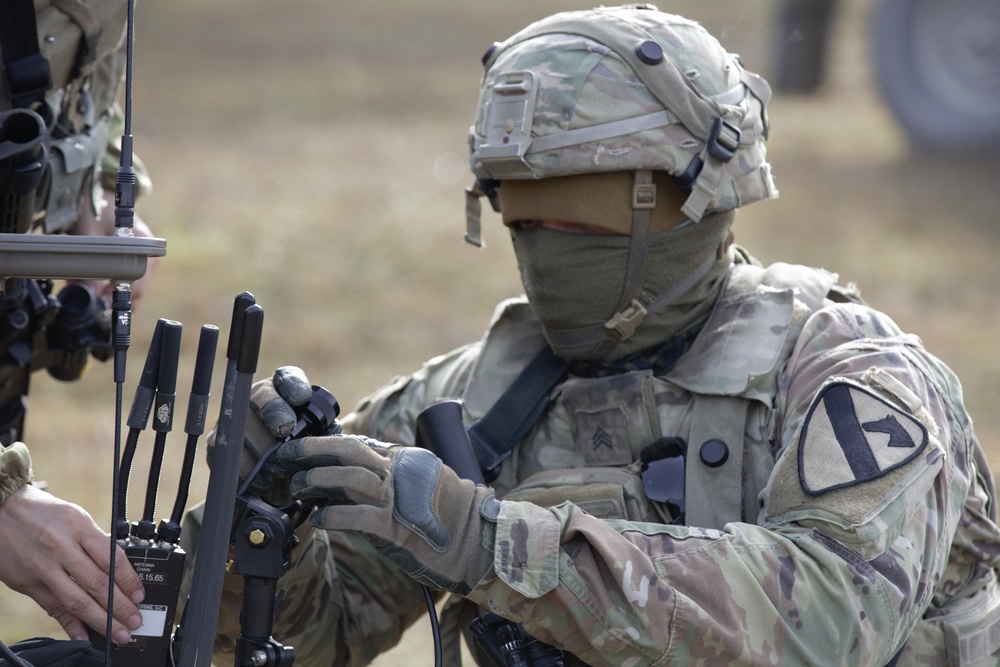
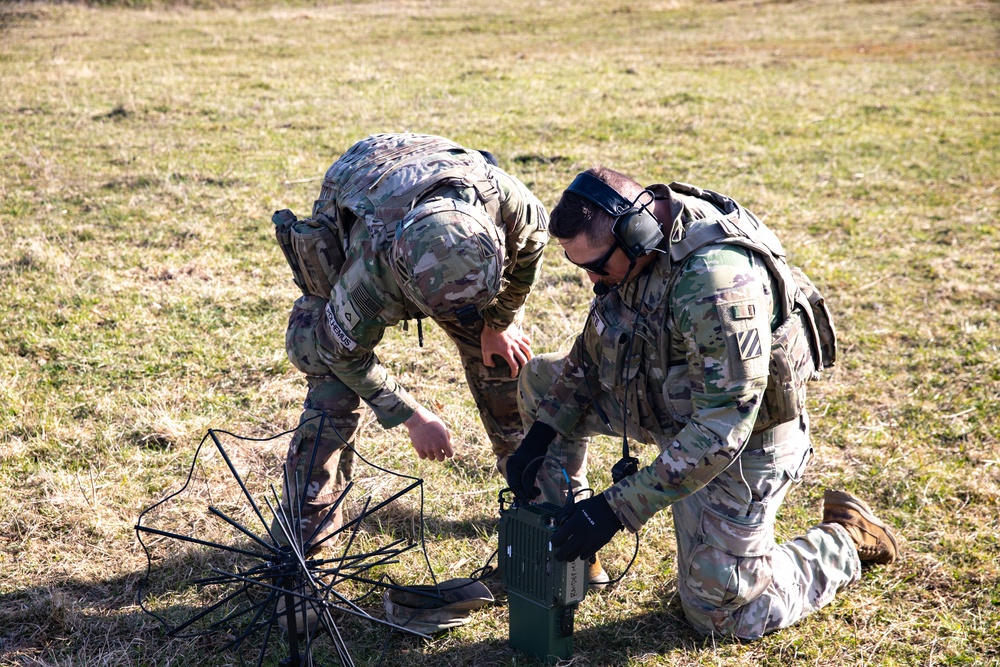
An Army account of Combined Resolve 25-02 described the Beast+ system supporting 3rd Infantry Division soldiers in scanning for enemy signals and identifying spoofing or jamming threats. That exercise provides a concrete example of EW supporting maneuver awareness. It should be read as an exercise account, rather than proof of autonomous response against every threat. Army exercise account, May 7, 2025.
The Army also describes its Electronic Warfare Planning and Management Tool as supporting spectrum visualization, planning, and management, with integration into next-generation command and control. MEMSS and planning tools address related but different needs: one supplies effects, while the other helps coordinate spectrum assets and decisions. Treating them as interchangeable obscures where integration work remains. Army EW program descriptions.
Put time-critical functions where the mission can reach them
Disconnected, degraded, intermittent, and limited-bandwidth conditions change the allocation of computing work. Time-critical sensing and permitted responses may need to remain on the platform because a remote service cannot meet the required availability or latency. Larger computing environments can still support training, analysis, threat-library development, and distribution of approved updates.
The engineering question is which functions must survive locally, with what power, cooling, processing, and storage. A software-defined radio still has physical limits: antenna coverage, bandwidth, dynamic range, power amplification, and thermal performance constrain what software can accomplish. Hardware readiness and model quality must be evaluated together.
Open interfaces can make modules easier to replace, but each substitution needs regression testing. A different receiver or accelerator can change timing, calibration, and model performance even when the interface remains compatible. Signed updates, known configuration states, and a recoverable baseline are particularly important when the deployed network is unreliable.
Five acceptance questions for an adaptive EW system
- Can the test set expose unfamiliar conditions? Include withheld emitters, altered waveforms, dense friendly traffic, and receiver degradation rather than relying only on familiar signatures.
- Does uncertainty change behavior? Require defined limits on automatic responses, operator escalation, and a safe handling path for ambiguous observations.
- Can the system operate within its local resource budget? Measure latency and sustained thermal performance on the actual platform, including network loss.
- Are effects coordinated? Test friendly interference, mission restrictions, and the operator's ability to inhibit or terminate an action.
- Can an update be explained and reversed? Preserve the model, signal-processing configuration, authorization, and test evidence associated with each release.
The advantage comes from repeating this cycle quickly without losing control of configuration or evidence. A procurement schedule alone cannot establish when a formation will be ready; readiness requires equipment, trained personnel, integration, and demonstrated mission performance to arrive together.
Sources and further reading
- CACI: January 2026 Army integration and sustainment task order
- Army: January 2026 industry briefing, including MEMSS
- ARL: FREEDOM research objectives
- Army: Beast+ at Combined Resolve 25-02
- Army: electronic warfare programs and integration
Spartan X brings AI, cybersecurity, and systems engineering together around these integration decisions: what must run locally, how its behavior is evaluated, and how operators retain control as software and mission conditions change.