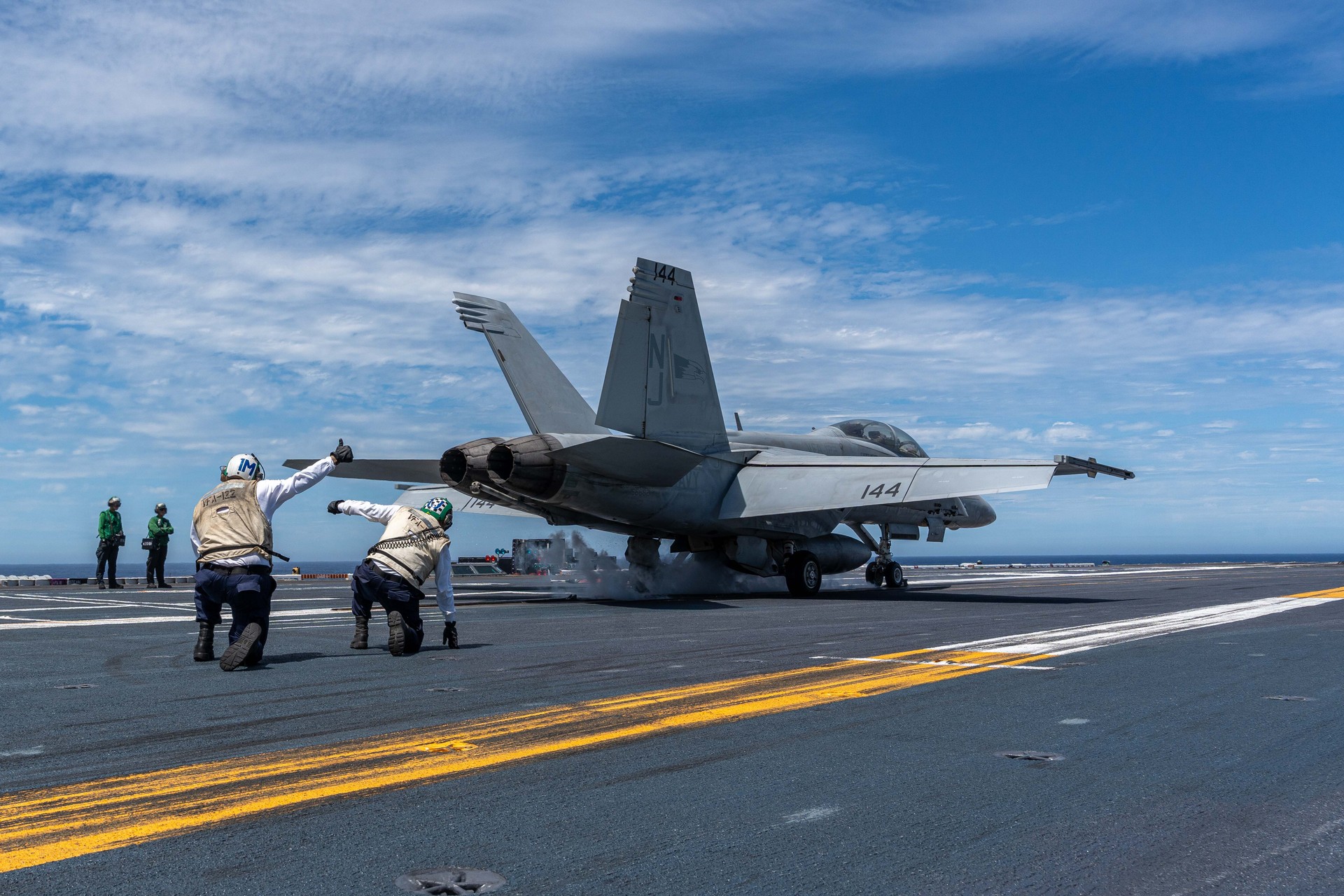
The Navy's Request for Information issued August 31, 2026, for a carrier-capable Collaborative Combat Aircraft marks something more significant than a routine market survey. For a decade, the Navy deliberately declined to pursue an autonomous combat aircraft for the carrier deck — canceling the X-47B's combat development after its carrier-landing demonstrations in 2013, and redirecting the unmanned carrier aviation investment toward the MQ-25 Stingray aerial refueling tanker. The new RFI reverses that strategic posture. The Navy now wants a combat drone that can launch from catapult, recover via arrested landing, carry four 2,500-pound class munitions, integrate into the same MD-5 control architecture already in use for the MQ-25, and be ready for shore-based carrier certification within three years of award. That combination of requirements is not modest, and it signals a fundamental shift in how the Navy intends to structure carrier air power for the next generation.
The carrier qualification constraint is what makes this program genuinely harder than its Air Force counterpart. The Air Force CCA program — Anduril's YFQ-44A and General Atomics' YFQ-42A — operates from conventional runways against a tractable set of airfield constraints. Carrier qualification imposes a different physics: catapult launch loads, arrested landing deceleration forces, corrosive salt-air and shipboard electromagnetic environment, and deck spotted within the footprint of a fourth-generation fighter. These requirements filter out a significant share of drone airframe designs that might otherwise compete. The RFI's spot-factor language — the CCA cannot consume more deck and hangar space than an existing fourth-generation fighter aircraft — is not an incidental detail. It tells industry that the Navy intends to integrate CCA into existing carrier air wing handling practices, not build a new deck operations concept around an oversized platform. That constraint, combined with the three-year shore-based certification timeline, puts extraordinary pressure on competitors to field carrier-ready designs without the extended developmental programs the Navy has historically run for new carrier aircraft.
The MD-5 Integration Signal
The requirement that CCA prototypes integrate with the MD-5 Unmanned Carrier Aviation Mission Control System is the most strategically important element of the RFI. MD-5 is the control infrastructure the Navy has been developing and maturing through the MQ-25 program; the Unmanned Carrier Aviation operator community — VUQ-10 at Patuxent River and the newly established VUQ-11 — has been building proficiency with it for years. By mandating MD-5 compatibility, the Navy is signaling that it intends to field carrier-based unmanned aviation as a system rather than a collection of independent platforms. A carrier air wing operating an MQ-25 for aerial refueling and a CCA for strike and escort, both controlled through the same operator interface and the same command architecture, is fundamentally different from one where each unmanned type requires its own proprietary ground control station and its own trained cadre. The MD-5 requirement reflects a doctrine bet: that investment in common control infrastructure compounds across unmanned platform generations, much the way the Air Force's experience with the Menace-T ground element for CCA has demonstrated that the control layer — not the airframe — is where joint tactics and operational doctrine actually live. The Navy appears to be making that bet deliberately rather than discovering it the expensive way.
Payload, Unit Cost, and What the Mission Profile Actually Demands
Four externally mounted weapons at 2,500 pounds each — five tons of total payload — places the Navy's CCA in a different mission category than ISR persisters or expendable attritables. The 2,500-pound class includes large bunker-buster munitions designed for hardened high-value targets. The Navy is not describing a scout or a sensor-forward sponge. The RFI describes a recoverable strike asset: one that penetrates contested airspace alongside F/A-18E/F and F-35C crews, delivers a meaningful weapons load, and recovers aboard the carrier for reuse. That mission profile imposes survivability requirements that attritable approaches — designed to be expended rather than recovered — cannot meet. A platform that must recover aboard a carrier after a strike in a contested environment must be survivable enough to complete the mission and return; a platform carrying five tons of live munitions must operate in exactly the threat environments that justify that payload. The $30 million target unit cost is aggressive for a carrier-capable aircraft meeting that profile, but it reflects the same competitive pressure that defined the Air Force CCA program from the outset. Primes unable to get within range of that number will not survive the downselect.
The Command-Authority Problem the RFI Does Not Solve
The harder problem the RFI does not address is the doctrinal and command-authority architecture required to task a CCA in a carrier strike group operating environment. The carrier strike group command structure was built around manned aviators, with authority over target sets, weapons release, and mission abort flowing through standing rules of engagement and real-time voice communication with aircrew. A CCA operating in the same threat environment — potentially with communications degraded, returning via a semi-autonomous flight profile while carrying live weapons — requires authority architecture that the Navy has not yet formally codified. The MD-5 system provides a physical operator control interface; it does not answer the question of who commands a CCA to abort a weapons release under contested communication conditions, or how flag-officer authority in the strike group commander's battle management role maps onto an autonomous platform making real-time engagement decisions. The Air Force has been working this problem through its Experimental Operations Unit exercises, with airmen making tasking decisions from simulated forward bases under live training conditions. The Navy's equivalent will have to account for the stricter communications environment of a carrier at sea, the multi-flag-officer authority structures of a strike group, and the simultaneous control of both MQ-25 tanker orbits and CCA strike packages from the same deck. Industry responses are due September 18, 2026, with an industry briefing scheduled September 22. The competition will produce the platform; the authority and doctrine work will have to run in parallel, and neither is likely to wait for the other.